The velocity of a falling object increases the longer it falls, and this
determines how far it goes in the next time interval. The picture shows the
position of a dropped ball at 0.1 sec, 0.2 sec, 0.3 sec, ... .
The ball positions cluster together at the beginning, but then get farther
and farther apart. A similar picture results for a ball that is thrown upwards, since
in this case, too, the ball velocity is small near the top of its
path. A practical application of this is in the tennis serve: the ball should
be thrown upwards so that it s highest point is right at the height
where you can hit it.
It will spend 0.2 seconds within 5 cm of the turn-around point --
plenty of time to hit it. Throwing the ball too high will mean that
it goes through the target region faster, and now your swing will have
to be much better timed.
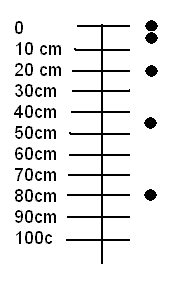 The velocity of a falling object increases the longer it falls, and this
determines how far it goes in the next time interval. The picture shows the
position of a dropped ball at 0.1 sec, 0.2 sec, 0.3 sec, ... .
The ball positions cluster together at the beginning, but then get farther
and farther apart. A similar picture results for a ball that is thrown upwards, since
in this case, too, the ball velocity is small near the top of its
path. A practical application of this is in the tennis serve: the ball should
be thrown upwards so that it s highest point is right at the height
where you can hit it.
It will spend 0.2 seconds within 5 cm of the turn-around point --
plenty of time to hit it. Throwing the ball too high will mean that
it goes through the target region faster, and now your swing will have
to be much better timed.
The velocity of a falling object increases the longer it falls, and this
determines how far it goes in the next time interval. The picture shows the
position of a dropped ball at 0.1 sec, 0.2 sec, 0.3 sec, ... .
The ball positions cluster together at the beginning, but then get farther
and farther apart. A similar picture results for a ball that is thrown upwards, since
in this case, too, the ball velocity is small near the top of its
path. A practical application of this is in the tennis serve: the ball should
be thrown upwards so that it s highest point is right at the height
where you can hit it.
It will spend 0.2 seconds within 5 cm of the turn-around point --
plenty of time to hit it. Throwing the ball too high will mean that
it goes through the target region faster, and now your swing will have
to be much better timed.