A fluid is a material that can flow, like water or air.
The kinds of energy that are important to a fluid are kinetic
energy (because it can move) and gravitational energy (because it
has weight). Water flowing downhill is converting gravitational
energy into kinetic energy.
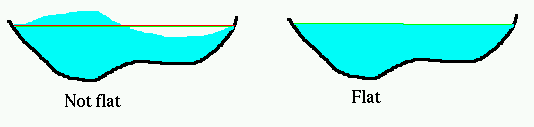
We can use the energy concept to explain why the surface
of a pond is flat. Suppose there is a pond whose surface is not
flat. Then the "hill" of water on one side can move into the
"valley" on the other. Water has moved downwards, decreasing
its potential energy.
The surface is flat because this gets the water as
low as possible.
That explanation depends on the assumption that the water has mass
and occupies a volume that is proportional to the mass. If we could
pack more mass into the same volume, the water wouldn't have to move
from one side of the lake to the other). The ratio of mass to volume is
called the density.
density = mass/volume
The density of liquid water is 1000 Kg/m3 (that may seem like a
big number, but a cubic meter of water is a lot!).
Buoyancy
Objects seem to weigh less under water -- indeed, some objects float
to the top instead of sinking to the bottom, as if their weight were
negative. We can explain this using energy ideas.
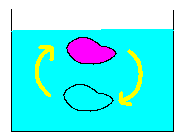
As the rock moves up ...
...water moves down
Consider what happens as we raise
an underwater object --let's say, a rock -- from one level to another.
When the rock moves, some water has moved, too: away from the
place the rock will be, and into the place where it was.
The net effect is that a "piece of water" exactly the same shape
as the rock has moved downward as the rock itself has moved up, as if
they had changed places with each other. The gravitational energy
of the rock has increased, but the gravitational energy
of the piece of water has decreased, and so the energy we need to
supply is just the difference
between these two amounts of energy. The "piece of water" serves as a
counterweight for the rock. The energy we supply in lifting the rock
while it is underwater is less than the energy we supply in lifting it
in air, and since
energy transferred = force x distance
this means the force we exert is less.
The apparent weight of the rock is the actual weight minus the weight of
the piece of water it displaces. Lifting a bag full of water while it is
under water requires no force at all.
If an object has a small weight and a large volume, it might displace
more than its own weight of water, and then the object will float. The
condition can be stated simply in terms of densities: if the average density
is less than the density of water, the object will float.
Helium balloons and hot air balloons work the same way, only now it is
air that is displaced, instead of water.
 We can use the energy concept to explain why the surface
of a pond is flat. Suppose there is a pond whose surface is not
flat. Then the "hill" of water on one side can move into the
"valley" on the other. Water has moved downwards, decreasing
its potential energy.
The surface is flat because this gets the water as
low as possible.
We can use the energy concept to explain why the surface
of a pond is flat. Suppose there is a pond whose surface is not
flat. Then the "hill" of water on one side can move into the
"valley" on the other. Water has moved downwards, decreasing
its potential energy.
The surface is flat because this gets the water as
low as possible.