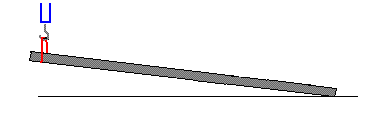
 1. Determine the force required to lift one end of the 1/2 meter stick, pulling up
on a loop of string around the end.
1. Determine the force required to lift one end of the 1/2 meter stick, pulling up
on a loop of string around the end.
Energy and Levers
Levers are useful because they allow us to use a small force to accomplish something that would ordinarily require a large force. Let's investigate the energy relationships that are involved.
Materials:
1. Determine the force required to lift one end of the 1/2 meter stick, pulling up
on a loop of string around the end.
2. Determine the force required to lift one end of the stick with the 2 Newton weight on it somewhere near the middle of the stick (mark where you put it!). Part of this force is due to the stick -- we measured this in part 1. Subtract this off to find the part of the force needed to lift just the weight.
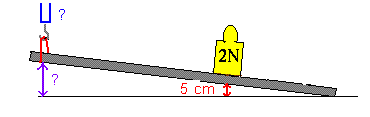 3. Note how high you will have to lift the end of the stick, in order
to raise the weight 5 centimeters.
Measure these distances between the table top and the bottom of the stick,
because these start out at zero when the stick is flat on the table.
3. Note how high you will have to lift the end of the stick, in order
to raise the weight 5 centimeters.
Measure these distances between the table top and the bottom of the stick,
because these start out at zero when the stick is flat on the table.
4. Multiply the force you exerted (the part just for the weight) times the distance you raised your end of the stick, to find the energy you provided.
5. How much energy does it take to lift a 2 N weight 5 centimeters, without using the lever?
6. Compare the results of Question 4 and Question 5.
Check the box when you are done:
Science content: Force and energy