Invisible Light Visible
light represents only a small part of the electromagnetic spectrum.
We simply can't see most of the light around us because most is invisible
to our eye. Light that is lower frequency than red is infrared light,
and still lower are microwaves, TV, and radio waves. Light that is higher
frequency than blue is ultraviolet, and still higher are Xrays and gamma
rays. These are all electromagnetic waves -- they travel at the same speed,
and reflect and refract just like visible light.
Infrared light is emitted by warm objects -- even people!
Incandescent light bulbs give off most of their energy in the form
of invisible infrared light. Fluorescent light bulbs are more energy
efficient
because they turn more of the electrical energy into visible light.
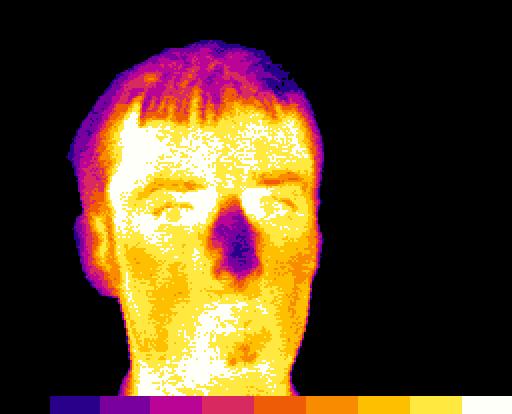
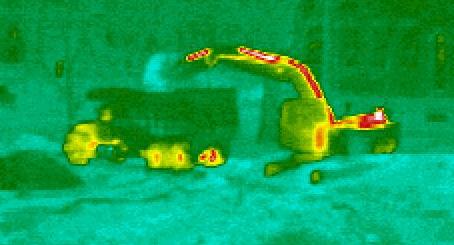
Here are some images taken by a special TV camera that is
sensitive only to infrared light. The picture is colored blue and
green where the infrared light is dim,
and red and yellow where it is bright, because these correspond
to the cool and warm parts of the object.
A backhoe loading dirt onto a truck. The bright parts correspond to
the engines of truck and hoe, the brakes of the truck, the hydraulic system
of the backhoe, and the two operators.
This man's nose is cool, and he is warmest around his eyes.
Infrared pictures provided by the University of
Kentucky College of Engineering -- Kentucky Transportation Center
X-rays are extremely short wavelength -- a thousand times
shorter than visible light. This means they are also very high frequency.
X-rays can penetrate matter because they are so high frequency that
the atoms cannot respond very much.
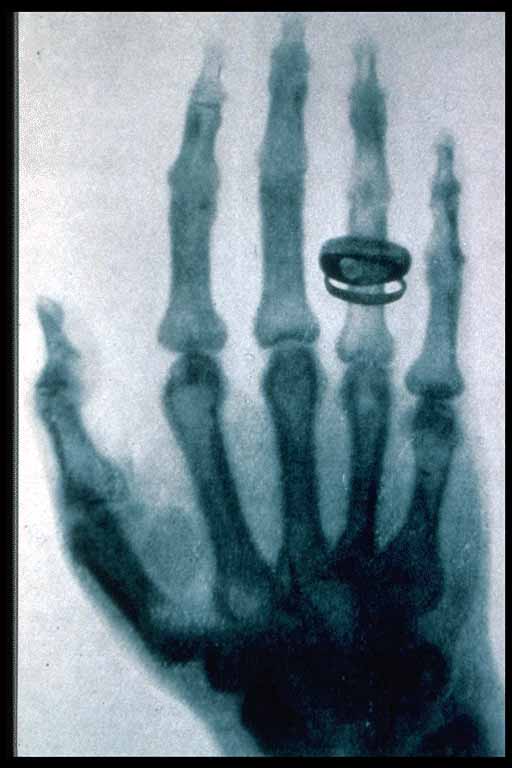
Xrays can go through flesh but are slightly absorbed by bones.
This photograph reveals the bones in a man's hand (as well as his
ring), as shadows.
Reprinted with permission of the American College of
Radiology, Reston, Virginia. No other representation of this material
is authorized without express, written permission from the
American College of Radiology