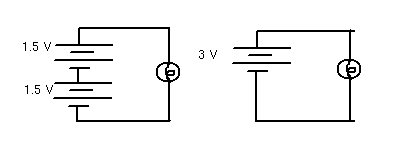
 are two circuits. Assume that the current in each circuit
is 2 Amperes. How much power is each battery producing? How much power is being delivered to
the light bulb, in each case? Use a similar pair of circuits to demonstrate that any pair of
batteries in series is equivalent to a single battery with a higher voltage.
are two circuits. Assume that the current in each circuit
is 2 Amperes. How much power is each battery producing? How much power is being delivered to
the light bulb, in each case? Use a similar pair of circuits to demonstrate that any pair of
batteries in series is equivalent to a single battery with a higher voltage.
 Suppose your car has a weak battery. The radio will play and the lights go on (a bit orange, perhaps),
but the engine won't turn over. Using a set of jumper cables you can get the car started.
The instructions say
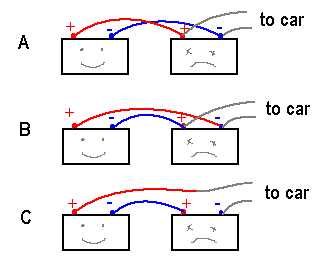
to connect the plus terminal of one battery to the plus terminal of
the other battery, and then connect the car frame of one car to the
car frame of the other car (this is equivalent to connecting the
negative terminals, as in diagram A).
Suppose your car has a weak battery. The radio will play and the lights go on (a bit orange, perhaps),
but the engine won't turn over. Using a set of jumper cables you can get the car started.
The instructions say
to connect the plus terminal of one battery to the plus terminal of
the other battery, and then connect the car frame of one car to the
car frame of the other car (this is equivalent to connecting the
negative terminals, as in diagram A).
Other ways to connect the jumper cables would be to connect plus-to-minus, minus-to-plus (diagram B), or to connect the batteries in series (by disconnecting the wire at the positive terminal of the dead battery and connecting it instead to the positive terminal of the good battery, and then connecting the negative terminal of the good battery to the positive terminal of the dead battery, as shown in diagram C). What unpleasant results would these options give?