Instructions for:
Crystals
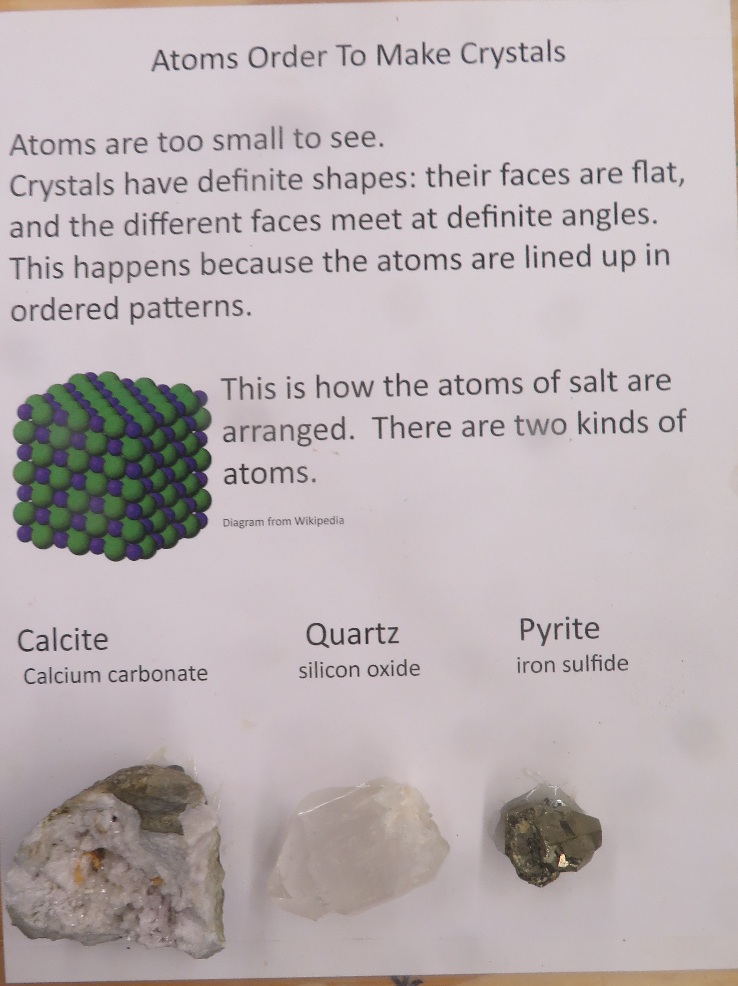
The local order prevents atoms from moving past each other easily. Crystals often are stiffer than noncrystalline materials, more transparent, and can have anisotropic properties. For example, engineered magnetic materials are made of long thin crystals that are all aligned the same way; this fixes the axes of the magnetic poles.
Atoms are really tiny: too small to see even with the very best microscope. The existence of crystals was one of the first hints that atoms actually exist.
Salt and sugar are purified by dissolving them in hot water and then letting them crystallize as the water cools. The atoms of impurities don't fit into the crystal structure, so that the resulting crystals are much more pure than the starting material. With a hand lens you can see the crystals.
Rocks have crystals in them if they were formed by slow cooling or were in contact with water for a long time.
Copyright 2014 Joseph Straley - The University of Kentucky Physics Petting Zoo