Instructions for:
Roller Coaster
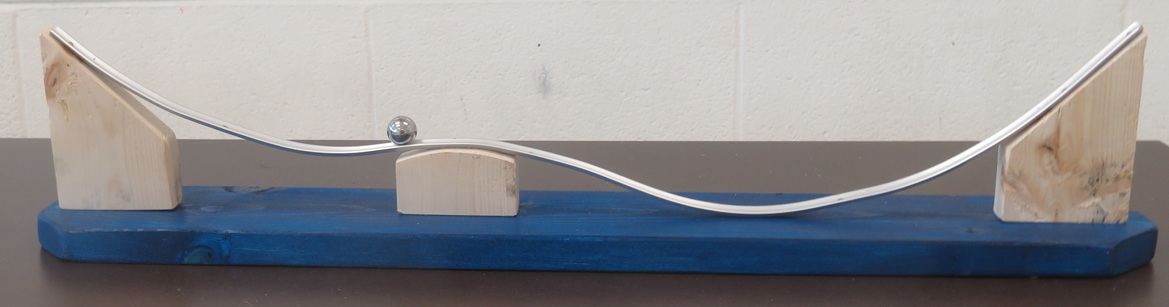
The Roller Coaster is a aluminum track mounted on a wooden platform, which demonstrates the principles of gravity and conservation of energy. A steel ball, included with the zoo, is released at one end of the track. It rolls readily to the other end, slowing down at a raised bump in the track. The ball will roll back and forth quite a few times, provided the track is kept smooth and free of obstructions.
When the ball is high on the track, its energy is in the form of gravitational potential energy. This gets traded in for kinetic energy as it rolls down. The sum of the two kinds of energy stays almost constant.
This demonstration does not include a laminated card.
Care should be taken to avoid loss or damage of the steel ball, as any irregularities in its surface result in a drastic change ball’s rolling ability. Also, do not re-bend or otherwise modify the track unless absolutely necessary. Any scratches or uneven creases in the rolling surface will stop the ball very quickly.
Questions for Students:
Q1) How high is each end of the track? What happens when you raise one end up a little bit (by placing a book under one end)?
Q2) How fast does the ball move at the bottom of the hill? At the top of the bump? At the ends of the track?
Q3) Can you release the ball so that it is caught in the little trap above the hump in the middle? (This requires patience, and maybe a mark on the track surface – use a marker. It is an interesting challenge.)
Copyright 2004 Straley/Pinney - The University of Kentucky Physics Petting Zoo