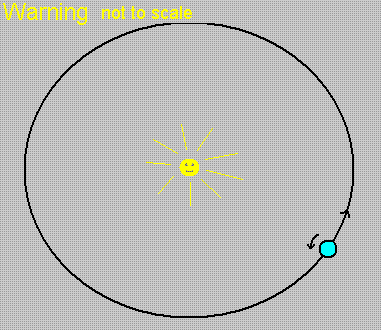
The first successful application of the physical laws of motion was in understanding
how the solar system works. The time between successive full moons is always the same:
the moon moves without slowing down. According to the law of everyday motion, this would
require having something push it. But actually the moon isn't being dragged across the
sky; it's just coasting at constant speed. (In this example we ignore the gravitational
attraction of earth and sun; without them, the moon would travel in a straight line, and
soon be out of sight).
Oceans, lakes, rivers, and canals were very important to transportation before the railroad
and the highway. Water provides a horizontal surface, and it isn't very hard to push
it out of the way. A barge is much more isolated from the rest of the world than a
sledge or even a wagon. A donkey or two was enough to keep tons of coal moving.
The situations in everyday life where we become aware of the law of inertia tend
to involve massive moving objects, such as locomotives, heavily loaded trucks, or large
linebackers. Left to themselves, these objects would move in a straight line at constant
speed. Mass becomes important because this determines how hard it is to make the object
stop or change direction.
The Law of Inertia is the secret to riding a bicycle. When the bicycle is not moving,
it will fall over to one side or the other, and once this starts, there is
nothing you can do to stop it (except to put one foot to the ground). But it
is easy to "stay up" when the bicycle is moving.
When you sense that you are falling to the right, you turn the handle bar so that the bicycle moves to the right. Meanwhile, you move in a nearly straight
line at constant speed. Soon the bicyle is back under you.
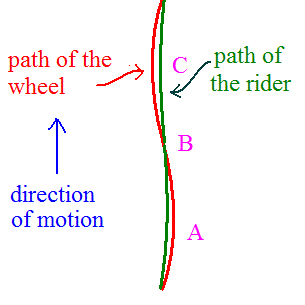
For example, the diagram at right shows the path of the
bicycle wheel and the rider, seen from directly above. At point A, the
rider realizes that she is too far to the left, and is falling over to that
side.
So she steers the bicycle to the left, with the result that it is back under
her at point B. With practice, we learn to do this so that the rider ends
up right over the bicycle. But in the example shown, the bicycle and the rider
are going in different directions at B, and soon the rider is falling over
to the right, at point C. By again steering to the right, the bicycle moves back under
the rider.
Things all around us are moving at many different speeds. Speed and motion
are so common that we usually just accept them as a normal part of life and
don't think specifically about measuring them. When we actually measure some
speeds, even the simple question "how fast does it go?" can become interesting,
as the speeds of some everyday motions show. Putting them in a list together
highlights the tremendous range of possibilities. To determine the speeds that
are listed, someone had to measure a distance moved, and a time span during
which the motion occurred.
The continents are drifting a few centimeters per year, which is 0.000 000 003 m/sec.
An inchworm in a hurry travels a centimeter in a few seconds at 0.003 m/sec.
A comfortable walking speed is 0.75 m/sec.
A light breeze blows at 2 m/sec.
The world's record for running 1 km corresponds to 7 m/sec.
A car moving at 60 mph goes 27 m/sec.
The speed of sound in air is 325 m/sec.
Due to the rotation of the earth, a person standing still on the equator moves 440 m/sec to the east.
The speed of the earth as it goes around the sun is 30,000 m/sec.
The speed of light is 300,000,000 m/sec.
Sometimes speed is (nearly) constant, and sometimes it distinctly varies.
A bicycle can coast at nearly constant speed on a level road, but it slows as
it goes uphill and then speeds up on its way down. A hockey puck glides
across the ice until it encounters a stick that causes a change in speed and a
change in direction. Some kinds of birds fly or glide in a straight line, while
others dart back and forth, changing speed and direction unpredictably.
When a clock pendulum swings back and forth, it goes fast at the low point
of its arc and slows to a stop at the high points. A screen door on a spring
hangs open momentarily and then speeds up to slam shut.
 The Law of Inertia is the secret to riding a bicycle. When the bicycle is not moving,
it will fall over to one side or the other, and once this starts, there is
nothing you can do to stop it (except to put one foot to the ground). But it
is easy to "stay up" when the bicycle is moving.
When you sense that you are falling to the right, you turn the handle bar so that the bicycle moves to the right. Meanwhile, you move in a nearly straight
line at constant speed. Soon the bicyle is back under you.
For example, the diagram at right shows the path of the
bicycle wheel and the rider, seen from directly above. At point A, the
rider realizes that she is too far to the left, and is falling over to that
side.
So she steers the bicycle to the left, with the result that it is back under
her at point B. With practice, we learn to do this so that the rider ends
up right over the bicycle. But in the example shown, the bicycle and the rider
are going in different directions at B, and soon the rider is falling over
to the right, at point C. By again steering to the right, the bicycle moves back under
the rider.
The Law of Inertia is the secret to riding a bicycle. When the bicycle is not moving,
it will fall over to one side or the other, and once this starts, there is
nothing you can do to stop it (except to put one foot to the ground). But it
is easy to "stay up" when the bicycle is moving.
When you sense that you are falling to the right, you turn the handle bar so that the bicycle moves to the right. Meanwhile, you move in a nearly straight
line at constant speed. Soon the bicyle is back under you.
For example, the diagram at right shows the path of the
bicycle wheel and the rider, seen from directly above. At point A, the
rider realizes that she is too far to the left, and is falling over to that
side.
So she steers the bicycle to the left, with the result that it is back under
her at point B. With practice, we learn to do this so that the rider ends
up right over the bicycle. But in the example shown, the bicycle and the rider
are going in different directions at B, and soon the rider is falling over
to the right, at point C. By again steering to the right, the bicycle moves back under
the rider.