Energy and the Tow Truck
We can move a cart to to a higher level using a steep incline, or one that is not steep at all. Do the different ways to lift the cart require different amounts of energy?Materials
Set up a stack of books or a box about 30 cm high. This represents a hill. We want to get the cart to the top of the hill, using a ramp. We ramp can be gradual, or steep.
|
|
|
Calculating energy
It takes energy to lift something. The amount of energy you have to transfer to the object depends on how hard you have to pull (the Force) and how far you move it (the distance) in the direction of the force.
Energy = Force (in Newtons) x Distance (in meters).
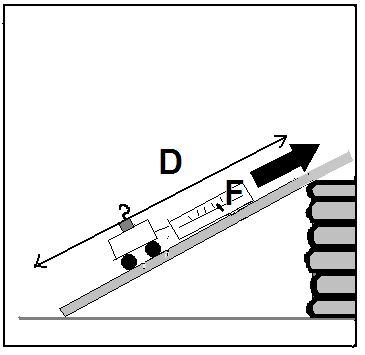
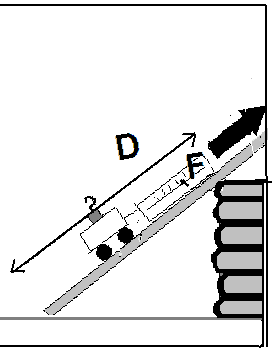
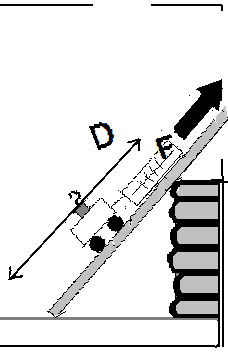
The force and the distance must be in the same direction. The diagram shows the quantities we need to measure. Note that the part of the board that extends beyond the top of the hill doesn't count, and the height of the hill remains fixed. The units of energy are Joules. 1 Joule = 1 Newton x 1 meter
| F (Newtons) |
D (meters |
Calculate energy
E = F x D (Joules) |
|---|---|---|
2. Another way to get the cart to the top of the hill is to lift it straight up. Now the force is the weight of the cart, and the distance is the height of the hill. Add this line to your table.
Check the box when you are done: